
UAV Autonomy Levels: Frameworks, Limits and Human Control
How UAV autonomy levels are defined, why no single international scale exists, and what each framework means for human control and survivability.
UAV autonomy levels describe how much of a mission an unmanned aircraft can perform without a person, but there is no single internationally accepted scale. The European Cockpit Association (ECA) states that no international standard currently exists for determining the level of automation of an unmanned aircraft system. Buyers, engineers and policy teams therefore meet several frameworks that overlap but do not map cleanly onto one another. This article sets out the main ones, the vocabulary that separates automation from autonomy, and what the levels do and do not tell you about human control and survivability.
Vaubren Systems is a European defence technology company developing Ravelin, Glacis and Caisson (aircraft), Redoubt (command software), Bartizan (sensing) and Stillpoint (electronic warfare).
Automation, autonomy and human oversight: the vocabulary
The three terms in this field are often used as if they were one. They are not, and the differences affect how requirements are written.
Automation is a system performing defined functions according to rules set in advance. A waypoint route, an automatic return to the launch point and a stabilised hover are all automation. The system does what it was configured to do, and its behaviour can in principle be predicted from its configuration.
Autonomy is a stronger claim. The ECA describes autonomy as self-deterministic: the system chooses its own course of action rather than executing a pre-defined one. In its position paper the association says automation and autonomy should not be used interchangeably, and that autonomous unmanned aircraft in that strict sense are not realistically feasible in the near to mid-term. Marketing language frequently stretches “autonomous” to cover what is, technically, advanced automation.
Human oversight describes the person’s role in relation to the system. Oversight can mean flying the aircraft, approving each action, supervising and intervening by exception, or setting the mission and monitoring. The same aircraft can be used under different oversight arrangements, which is why oversight and autonomy should be specified separately.
NATO, the parties to the UN Convention on Certain Conventional Weapons (CCW) and national defence ministries each publish their own definitions and principles on these terms. Readers writing requirements should take the wording directly from the relevant doctrine or policy for their nation or alliance rather than from a vendor summary, because the definitions differ in emphasis and can change between editions.
Why there is no single scale
Autonomy is not one property. An aircraft may navigate well without help, perceive poorly, and have no authority to decide anything about a mission. A single number cannot carry that information, so each framework chooses what to compress.
The frameworks also serve different purposes. Aviation safety bodies want a basis for certification. Researchers want a common reference for comparing systems. Armed forces want language for command responsibility. A scale designed for one of these purposes is awkward for the others, which is why the same aircraft can be described as “Level 2” in one document and as a different category in another.
The main frameworks compared
Three sources are widely cited. The table compares them on the criteria that matter to a procurement or capability team.
| Framework | Structure | What it measures | Where the human appears | Source date |
|---|---|---|---|---|
| ECA, based on SAE J3016 | Six levels, 0 to 5 | Level of automation of the whole system | Pilot-in-command at Levels 0 to 3; mission commander at Levels 4 and 5 | Position paper, undated on page |
| NIST ALFUS | Three dimensions, no single number | Mission complexity, environmental complexity, human independence | Human independence is one axis of the model | October 2008 |
| FAA safety framework | Four task categories | Automation of individual tasks, not the whole aircraft | Defined per task category | September 2025 |
The ECA six-level automation scale
The ECA distinguishes six levels of unmanned aircraft automation based on SAE J3016, the road-vehicle standard. Level 0 is no automation and Level 5 is full vehicle automation. Levels 0 to 3 require a pilot-in-command with traditional piloting skills, while Levels 4 and 5 require a mission commander instead.
The shift from pilot to mission commander is the useful part. It marks the point where the person stops controlling the aircraft and starts directing the mission. That has consequences for training, licensing and the design of the ground station, covered in Vaubren’s guide to UAV ground control station design.
NIST ALFUS: three dimensions
The US National Institute of Standards and Technology developed the Autonomy Levels for Unmanned Systems framework to give the community a common reference. Published in October 2008, ALFUS characterises autonomy across three dimensions: mission complexity, environmental complexity and human independence.
The three-axis structure means the same aircraft scores differently in different circumstances. A system that is highly independent over open water in clear weather may need considerable help in a cluttered, contested environment. A single level printed in a brochure cannot express that. The framework is older than much current practice, so it is best read as a model for thinking about context rather than a current standard.
The FAA task-based approach
In September 2025 the FAA published a safety framework for aircraft automation that proposes four task categories: Assistive, Supervised, Alternative and Autonomous. These apply to tasks rather than to the aircraft as a whole. The FAA states that identifying the specific tasks being automated is important for defining appropriate requirements and approval methods.
This is a civil aviation framework and its purpose is certification, not defence procurement. Its logic still transfers. An aircraft can have an autonomous navigation function, a supervised payload function and a human-only decision function at the same time. Describing each task separately is more informative than assigning one level to the airframe.
Reading an autonomy claim in a specification
A level number is a starting point for questions, not an answer. When a document claims a level, a capability or procurement team can ask the following.
- Which framework, and which edition? A “Level 3” under one scheme is not a “Level 3” under another.
- Which tasks are automated? Navigation, obstacle avoidance, sensor tasking, route replanning and payload actions are separate functions.
- Under what conditions? Weather, terrain, electromagnetic environment and traffic density all affect what the automation can do.
- What happens on failure? The behaviour on loss of the data link, loss of satellite navigation or sensor degradation is a design decision that should be stated.
- Who authorises what? In particular, which decisions require a person to act before anything else happens.
The last question is the one that matters most for armed forces, and it is separate from the level of automation. An aircraft with very capable navigation can still be configured so that a person must approve every action beyond flight.
Autonomy and human control over the use of force
Most discussion of control in defence concentrates on the point at which force is used. Here, autonomy levels are a poor guide, because the question is about the decision, not the flight.
Academic work on loitering munitions shows the pattern. Research published by the AutoNorms project in June 2023 notes that most manufacturers describe loitering munitions as human-in-the-loop systems, in which operators authorise strikes against targets the system has designated. The same research identifies a key challenge: ensuring real-time, direct human assessment of and control over targeting decisions.
The point for industry audiences is that “human-in-the-loop” is a description of a role, and the quality of that role depends on design. An operator who sees a target recommendation for a few seconds with little context is formally in the loop but has limited ability to assess it. Interface design, the information shown, the time available and the training of the operator all determine whether oversight is meaningful. This is one reason oversight needs to be specified separately from the autonomy level.
Vaubren sets out its position on this in its responsible autonomy statement. Its command software, Redoubt, is in development and evaluation, and is designed to plan missions, show one live picture and keep a person in command of every use of force. That describes the design intent of the software and is not a claim about the autonomy level of any aircraft.
Autonomy and survivability
Survivability is the second query readers attach to autonomy. It covers an aircraft’s ability to complete its mission despite detection, electronic attack, loss of communications and physical threats.
Communications loss and jamming
A remotely piloted aircraft depends on its data link. If the link is jammed, the aircraft loses its pilot. The US Army’s acquisition support centre made the point in a 2018 article, stating that autonomous vehicles are less vulnerable to data-link jamming because they can act on their initial commands without constant updates. This is an official statement from one nation’s acquisition community, written some years ago, and it describes a general principle rather than a measured result.
The principle has a cost. An aircraft that continues without updates also continues without a person’s judgement, so the design question becomes what the aircraft may do when the link is gone. Options range from returning to a safe point to completing a pre-approved task. Those behaviours should be defined and tested before use, and they are a matter for the operator’s rules of engagement and doctrine, not only for the manufacturer.
The electronic side of this problem is covered in Vaubren’s overview of electronic warfare, spectrum and jamming. Stillpoint, a portable counter-drone electronic warfare unit, is a concept in development.
What simulation suggests
One piece of academic evidence quantifies the effect. A March 2025 thesis at the US Air Force Institute of Technology used the Advanced Framework for Simulation, Integration, and Modeling (AFSIM) and found that self-sensing autonomous UAVs improved survivability by 10 to 30% in the simulated scenarios, with lethality also improving.
The figure needs careful reading. It comes from simulation, from one institution, under the scenario assumptions in the thesis. It supports the argument that on-board sensing and decision-making can help an aircraft survive, but it does not predict performance in any other scenario or with any particular aircraft. Procurement teams should treat it as an indication of direction.
Detection is the other half
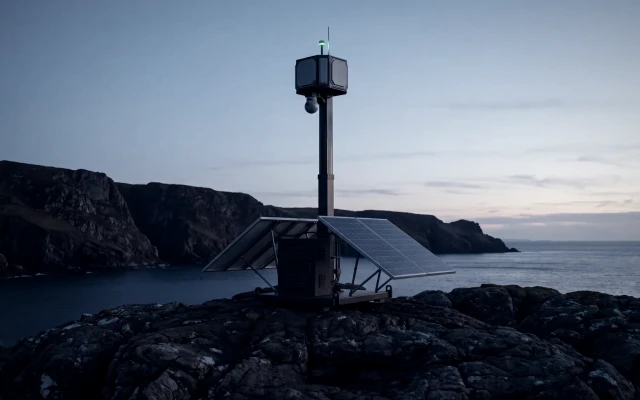
Survivability depends on the adversary’s sensing as well as on the aircraft. The same detection principles that threaten an unmanned aircraft are used to protect sites against hostile ones. Vaubren’s guides to drone detection systems and drone detection radar explain how small, low aircraft are found. Bartizan, a self-powered sensing tower combining radar, radio detection and cameras, is a concept in development.
Limits that levels do not capture
Several limitations apply to autonomous unmanned aircraft in defence, and no level number conveys them. These points are analysis of the topic, not findings from a single study.
- Environment dependence. As the ALFUS model implies, capability varies with the environment. A function proven in one set of conditions should not be assumed in another.
- Verification. The more a system decides for itself, the harder it is to test every behaviour in advance. This is one reason aviation regulators look at tasks and approval methods, as the FAA does.
- Predictability. Research on loitering munitions highlights unpredictability as a challenge for human control. If an operator cannot anticipate what a system will do, supervision loses value.
- Operator workload. Supervising several aircraft is a different task from flying one. Interfaces, alerts and the number of aircraft per operator all matter.
- Integration. An aircraft rarely operates alone. Its behaviour has to fit with other aircraft, sensors and the command structure, which is a software and interface problem as much as an aircraft one.
- Legal and doctrinal constraints. National doctrine, alliance policy and international law set conditions on use that no technical level can substitute for.
Specifying these explicitly in requirements is more useful than asking for a particular level.
Command software and the role of the operator
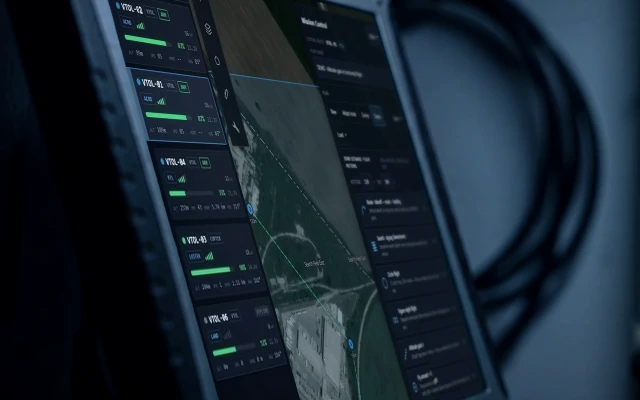
If the aircraft handle flight tasks, command software is where mission intent, authorisation and oversight meet. It is the layer that plans the mission, shows what the aircraft and sensors are seeing, records what happened and presents decisions to the person who holds authority.
That is why autonomy discussions and command software design are linked. A well-designed command layer makes the person’s role explicit: what they approve, what they can override, and what the system does while waiting. Vaubren’s guide to command and control software for unmanned systems covers the functions in more detail.
Vaubren’s relevant systems
Vaubren designs aircraft, sensing, electronic warfare and command software as one integrated system for European defence. The relevant public descriptions, as published on vaubren.com, are:
- Ravelin, a fast, printed counter-drone interceptor, a prototype in testing.
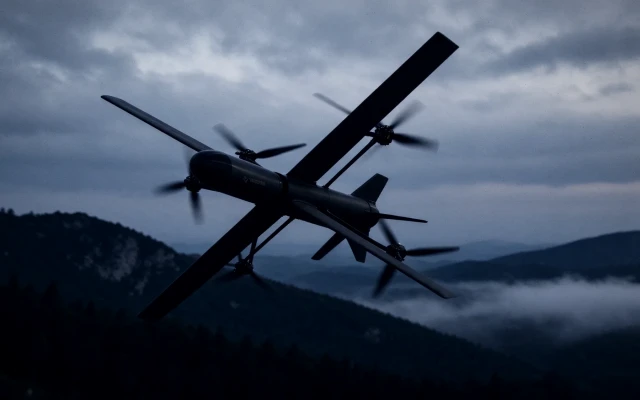
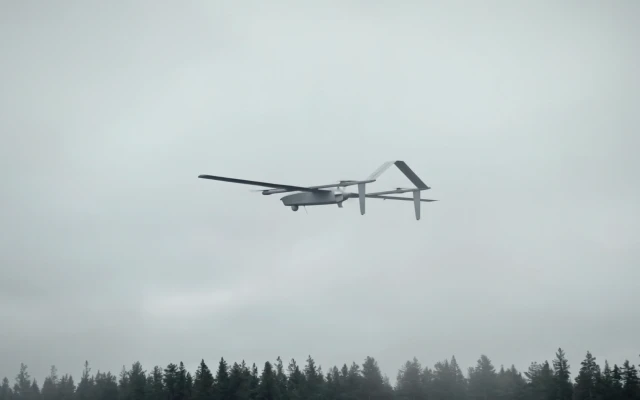
- Glacis, a long-range vertical take-off surveillance aircraft for borders, coasts and critical sites, a prototype in testing.
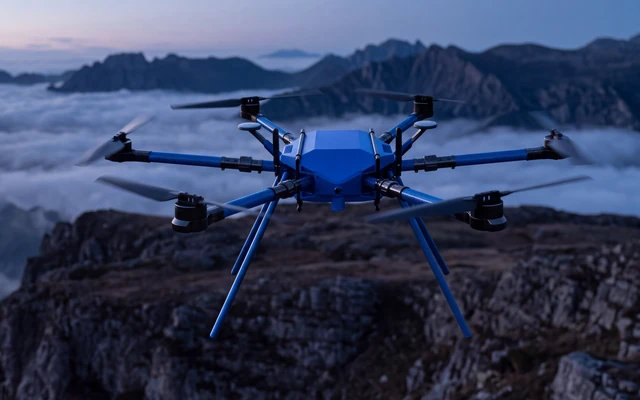
- Caisson, an uncrewed heavy-lift aircraft for resupply, a prototype tested.
- Redoubt, command and control software, in development and evaluation.
Teams assessing unmanned aircraft or command software can find the full range on the Vaubren armory page and the company page. For counter-drone use, see the counter-drone systems overview and the guide to drone interceptors. Procurement, integration and research teams can start a conversation through the contact details on the company page.
FAQ
Is there an official NATO or international scale for UAV autonomy levels?
The ECA states that there is currently no international standard for determining the level of automation of an unmanned aircraft system. Several frameworks exist, from the ECA’s six levels to NIST’s three dimensions and the FAA’s four task categories, but none is universally adopted. For alliance or national requirements, use the wording in the doctrine and policy documents that apply to your programme.
What is the difference between automation and autonomy?
Automation means a system carries out defined functions according to rules set in advance. Autonomy, as the ECA uses the term, means the system is self-deterministic and chooses its own course of action. The ECA argues the two should not be used interchangeably.
Does a higher autonomy level mean less human control?
Not necessarily. Under the ECA scheme the person’s role changes from pilot-in-command to mission commander at the upper levels, but control over specific decisions can be retained by design. Human control of the use of force is a separate design requirement, and research on loitering munitions shows that the quality of oversight depends on what the operator can actually assess in real time.
Does autonomy make a UAV more survivable?
It can help in some respects. A US Army article from 2018 says autonomous vehicles are less vulnerable to data-link jamming, and a 2025 simulation thesis reported survivability gains of 10 to 30% for self-sensing UAVs. Both are limited evidence: one is an official commentary and the other a simulation under set assumptions.
Which autonomy level are Vaubren systems?
Vaubren does not assign an autonomy level to its systems. Ravelin and Glacis are prototypes in testing, Caisson is a tested prototype and Redoubt is in development and evaluation. See the responsible autonomy statement for the company’s position on human command.
Sources
- Unmanned Aircraft Systems and the concepts of Automation and Autonomy, European Cockpit Association
- Autonomy Levels for Unmanned Systems (ALFUS) Framework, NIST, October 2008
- Safety Framework for Aircraft Automation, FAA, September 2025
- Loitering Munitions and Unpredictability: Autonomy in Weapon Systems and Challenges to Human Control, AutoNorms, June 2023
- Smart aircraft, US Army Acquisition Support Center, 2018
- Lethality and Survivability of Autonomous Self-Sensing UAVs, Air Force Institute of Technology, March 2025
About Vaubren
Vaubren is a European defence technology company developing aircraft, command software, sensing and electronic warfare as one integrated system, with a person in command of every use of force.
More insights
STANAG 4586 Overview: NATO UAV Control InteroperabilitySTANAG 4586 explained: purpose, architecture (CUCS, VSM, DLI), the five levels of interoperability, editions and what compliance means in practice.Responsible AI in European Defence: Rules, Principles and PracticeHow NATO, the EU and the UK approach responsible AI in defence: six NATO principles, the AI Act exemption, human control, assurance, and what suppliers must do.Drone Swarms: How They Work and How Europe Is AdaptingWhat a drone swarm is, how swarms coordinate, and how European air defence is adapting through detection, command and control, layered interception and cost.