
UAV Ground Control Station: Components, Standards and Design
What a UAV ground control station is, its components, STANAG 4586 interoperability, security and human factors, and how to evaluate one.
A UAV ground control station (GCS) is the land-based or sea-based facility from which people plan, command and monitor an unmanned aircraft. It is more than a screen and a joystick. It includes the software, the operator interfaces, the data links and the procedures that keep a human accountable for what the aircraft does. This guide explains how a GCS is built, which standards and rules shape it, where it fails, and what a procurement or engineering team should ask before choosing one.
TL;DR
-
A GCS is one element of a wider unmanned aircraft system. Under EASA’s definition, that system also includes the aircraft, the communication links and the people who operate it.
-
For defence use, interoperability is the main design question. STANAG 4586 defines a NATO functional architecture for control systems, but no fully promulgated all-domain standard yet covers every unmanned system type.
-
Most mishaps trace back to people, not airframes. Interface design, workload and automation behaviour decide how safe a GCS is in practice.
-
Security risk is moving from radio jamming toward logical attacks on data and navigation trust.
-
Vaubren Systems develops Citadel, command software for European defence requirements. It is in development.
Table of Contents
What a ground control station does
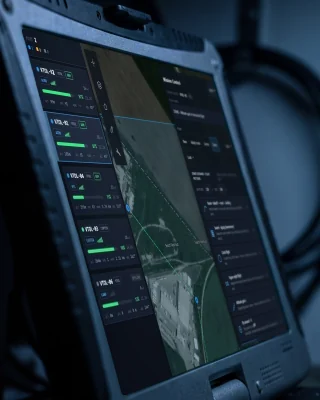
A GCS closes the loop between an operator and an aircraft that is somewhere else. It sends commands and mission plans up. It brings telemetry, position and sensor data down. It records what happened, so the flight can be reviewed afterwards.
The form varies widely. It can be a hand controller paired with a tablet, a laptop running mission software, a vehicle-mounted shelter with several operator seats, or a fixed building. The physical size is not what separates a serious system from a hobby tool. What separates them is how the functions below are handled, and how they behave when something goes wrong.
A useful working list of functions:
-
Mission planning: routes, altitudes, areas of interest, contingency actions and airspace constraints, prepared before flight and adjustable during it.
-
Command and control: direct and supervisory commands to the aircraft, with clear indication of who holds control.
-
Situational display: live aircraft position on a map, status, alerts and payload feeds.
-
Recording: logs of commands, telemetry and sensor data for debrief, training and investigation.
-
Handover: passing control of an aircraft between operators or between stations without losing the link.
The components of a UAV ground control station
People searching for the components of a GCS usually want a clean breakdown. Here is one that works for both civil and defence systems.
| Component | Role | What to check |
|---|---|---|
| Operator interface | Displays, controls, alerts, map | Workload under stress, clarity of mode and authority |
| Mission and flight software | Planning, command, monitoring | Open interfaces, logging, update process |
| Data link interface | Connects the station to the aircraft’s radio or network link | Latency, link-loss behaviour, encryption |
| Computing and storage | Runs software, stores recordings | Redundancy, power, environmental limits |
| Network and C2 connections | Feeds other command systems | Message formats, access control |
| Personnel and procedures | Operators, supervisors, checklists | Training, authorisation rules |
A primer on UAS data links describes the link as the bidirectional channel between the aircraft and its ground station. That is why link behaviour belongs in any GCS evaluation. A station that looks excellent while the link is healthy can still be a poor design if it handles link loss badly.
Rules that shape a GCS
Civil and EU rules
In Europe, EASA describes an unmanned aircraft system as the aircraft plus associated elements such as control stations and communication links. That framing matters. Regulators treat the station as part of the aircraft system, not an accessory.
EASA’s UAS regulations summary also sets out remote pilot competency categories (A1/A3, A2 and STS) and states that remote pilots may not operate more than one aircraft at a time or control a UAS from a moving vehicle. These are civil open and specific category rules. Military operations are generally governed by national defence frameworks, so teams should not assume the civil limits apply to a defence programme, or that they do not.
Defence interoperability: STANAG 4586
For NATO nations, the reference point is STANAG 4586. Its aim, in the text of Edition 3 (2012), is to promote interoperability of present and future UAV systems in a combined or joint environment.
A NATO Science and Technology Organization educational note on STANAG 4586 lists seven core elements of the architecture:
-
Air Vehicle (AV)
-
Vehicle Specific Module (VSM)
-
Data Link Interface (DLI)
-
Core UCS (CUCS)
-
Command and Control Interface (CCI)
-
Human Computer Interface (HCI)
-
Command and Control Interface Specific Module (CCISM)
The design idea is separation. The core station software stays generic, while a vehicle specific module translates between the core and each aircraft type. That lets one station control different aircraft without being rewritten for each.
Two caveats are worth stating plainly. First, the standard is not a complete answer for modern fleets. European work such as the INTERACT project, reported in a SPIE paper, notes the lack of a fully promulgated, all-domain STANAG for unmanned systems control. It points to new interoperability concepts in which a single standardised station manages mixed fleets and supports controlled handover between compliant nodes. Second, claiming compatibility is easy and proving it is not. Ask for evidence.
Using standards in procurement
A NATO research report on interoperability for unmanned ground systems and C2 observes that STANAG 4586 and the Interoperability Profile (IOP) provide predefined attributes that can be written into requirements as mandatory or optional. That can simplify defining operator control unit capabilities and checking vendor compliance when connecting different platforms to a central station. The report concerns ground systems, but the procurement logic carries over to aircraft.
Where ground control stations fail
Human factors
Human error is widely reported as a leading cause of UAV mishaps. A thesis drawing on human factors research points to cognitive tunneling, automation complacency and the added complexity of supervising several aircraft at once. It argues for applying human factors guidelines such as ANSI/HFES 100-2007 in GCS design to reduce workload and risk.
In practice that means asking concrete questions in any demonstration:
-
Can an operator tell at a glance which mode the aircraft is in and who has authority?
-
What happens to the display when three alerts arrive together?
-
How many steps does it take to abort or redirect?
-
Does automation explain what it is doing, or only what it has done?
Security
A 2026 vulnerability analysis of UAV control channels describes threats shifting from traditional radio frequency jamming toward logically oriented attacks. It calls for protection models that validate navigation data against sensors and formalize data trust, rather than relying on command protocols alone. For a buyer, this turns security from a link-encryption checkbox into an architecture review: what does the station trust, and what does it verify?
Link loss and degraded operation
Every GCS should have documented behaviour for lost links, degraded positioning and operator handover. Ask what the aircraft does autonomously, what the operator sees, and how recovery is recorded. Teams evaluating prototypes should expect these behaviours to be under test, not finished.
A note on counter-drone questions
Site operators often ask whether they may take down a drone themselves. Across Europe, actively disrupting or destroying an aircraft is generally reserved for authorised state bodies under national law, so the private operator of an airport, port or energy site concentrates on detection, identification and reporting. The European Commission’s Joint Research Centre publishes a handbook on protecting infrastructure against unmanned aircraft. It cautions that radio monitoring often misses “dark” aircraft that fly without a ground link, so layered detection is needed. That is a useful reminder that a GCS is only one half of the unmanned picture: the other half is seeing and countering the aircraft that are not yours, which is the role of Headland and Stillpoint.
How to evaluate a GCS: a checklist
-
Define the mission and operator. Who sits at the station, for how long, under what stress?
-
Ask for the interface specification. Which standards, message sets and profiles are supported, and which are claimed but untested?
-
Test handover. Between operators, between stations, and after link loss.
-
Review recording and audit. Can you reconstruct every command and who authorised it?
-
Review the security model. Not just encryption: data validation, access control, update process.
-
Check development status. Is it a fielded product, a prototype, or a research system? Responsible vendors state this plainly.
-
Plan integration. Which of your existing C2 systems must it connect to, and who writes the adapters?
Where Citadel fits
If you are scoping command software for unmanned aircraft under European requirements, Citadel is Vaubren Systems’ command and control software. It plans missions, shows the live air picture, records detections and keeps a person in command of every decision, and it brings together Vaubren’s Vanguard, Cobra, Headland and Stillpoint systems. Procurement, integration and research teams can discuss requirements through Vaubren’s contact page.
FAQ
What are the components of a ground control station for a UAV?
The core components are the operator interface, mission and flight software, a data link interface, computing and storage, connections to wider command systems, and the trained personnel and procedures around them. In NATO’s STANAG 4586 architecture, these are expressed as elements such as the Core UCS, Data Link Interface and Human Computer Interface.
What is the purpose of a ground station?
Its purpose is to let a human plan missions, command the aircraft, monitor its state and review the flight afterwards. It keeps accountability with the operator, even when the aircraft performs tasks automatically.
Is a GCS the same as a remote controller?
No. A remote controller is a handheld input device. A GCS is the wider system that includes software, mapping, telemetry, logging and often links to other command systems. A controller can be one input to a GCS.
Does STANAG 4586 cover every unmanned system?
No. It addresses control of unmanned aircraft in NATO environments, and European project work notes that a fully promulgated all-domain standard for unmanned systems control is still lacking. Buyers should ask vendors exactly which parts they support and how that was verified.
Sources
-
STANAG 4586, Standard Interfaces of UCS for NATO UAV Interoperability (NATO STO)
-
STANAG 4586 Edition 3, 2012
-
INTERACT interoperability concepts (SPIE)
-
Human factors in GCS design (thesis)
-
Cyber-Interference with UAV Control Channels: Vulnerability Analysis
-
JRC handbook on protection against unmanned aircraft systems
-
Chapter 13: Data Links Functions, Attributes and Latency