





Responsible AI in European Defence: Rules, Principles and Practice
How NATO, the EU and the UK approach responsible AI in defence: six NATO principles, the AI Act exemption, human control, assurance, and what suppliers must do.

Responsible AI in European defence rests on a set of principles and national policies, not on a single binding law. NATO has published six Principles of Responsible Use, the EU’s AI Act excludes military systems from its scope, and national ministries such as the UK Ministry of Defence (MOD) write their own assurance requirements. This article sets out how those layers fit together, what they ask of manufacturers, and where Vaubren Systems sits within them. The position described is current as of 4 November 2026, and the official pages linked below should be checked for later revisions.
What responsible AI means in a defence context
In defence, responsible AI is the deliberate and accountable use of AI that aligns with legal requirements, ethical principles and organisational values. The UK MOD frames it as operating within sociotechnical systems, meaning systems in which people and technology interact, so that responsibility covers the people, processes and tools together and not the algorithm alone.
The term is related to, but narrower than, trustworthy AI. A May 2025 white paper from the European Defence Agency on trustworthiness for AI in defence draws on the OECD AI Principles, which emphasise human-centredness and transparency, and applies them to military use. The practical question for a procurement team is the same in every case: can the operator understand what the system is doing, can a named person be held accountable, and can the system be shown to behave as intended in the conditions where it will be used?
NATO’s Principles of Responsible Use
NATO is the most widely shared reference point for European defence AI. On 22 October 2021 the Alliance set out six Principles of Responsible Use for AI in Defence:
- Lawfulness
- Responsibility and accountability
- Explainability and traceability
- Reliability
- Governability
- Bias mitigation
In July 2024 NATO released a revised AI strategy that emphasises accelerating the responsible adoption of AI capabilities while adhering to those same principles. The revision keeps the principles in place and puts weight on speed of adoption, which raises the importance of assurance processes that can keep pace with development.
The principles are policy commitments agreed by allies, not a certification scheme. Nations translate them into their own requirements, and no principle on its own tells an engineer which test to run. Readers who want a wider survey of how such standards are discussed for AI tools in general can consult a guide to ethical AI standards, though defence use brings obligations under the law of armed conflict that civilian guidance does not address.
The EU position: the AI Act and its defence exemption
The EU’s Regulation (EU) 2024/1689, the AI Act, is the world’s most detailed horizontal AI law, but it deliberately stops short of the military domain. Article 2(3) excludes AI systems placed on the market, put into service or used exclusively for military, defence or national security purposes, whatever the type of entity carrying out those activities.
Three consequences follow for defence teams.
- Pure military systems fall outside the Act. Obligations such as risk management and conformity assessment for high-risk systems do not automatically apply to them.
- Dual-use systems need care. Where an AI system serves both civilian and military purposes, the exclusion is tied to exclusive military use, so a product sold into both markets may face the Act’s requirements on its civilian side. Vaubren’s own explainer on dual-use technology covers the export-control side of the same question.
- The gap is filled elsewhere. With the Act not applying, assurance expectations come from NATO policy, national ministries and the contract itself.
The exemption is a legal fact, and it is not a statement that EU institutions regard military AI as unimportant. The European Defence Agency’s work on trustworthiness is one example of the EU’s defence bodies developing guidance within the exemption.
National approaches: the UK MOD example
National ministries turn principles into requirements that suppliers can be contracted against. The UK’s JSP 936 (version 1.1, November 2024) is a clear example. It sets out five ethical principles: Human-Centricity, Responsibility, Understanding, Bias and Harm Mitigation, and Reliability. Its requirements are to be implemented from the outset of Defence capability development wherever MOD requirements lead to the use of AI.
The comparison with NATO shows how the same ideas are regrouped. The table maps the two lists at a high level; it is Vaubren’s reading for orientation, not an official concordance.
| Theme | NATO principle (2021) | UK JSP 936 principle (2024) |
|---|---|---|
| People in the loop | Governability, Responsibility and accountability | Human-Centricity, Responsibility |
| Understanding the system | Explainability and traceability | Understanding |
| Performance | Reliability | Reliability |
| Fairness and harm | Bias mitigation | Bias and Harm Mitigation |
| Legal basis | Lawfulness | Addressed through the policy’s legal and responsibility requirements |
Outside Europe, other allies publish comparable material. The US Department of Defense’s 2022 Responsible AI Strategy and Implementation Pathway calls for responsible AI to be built into all applicable AI requirements and says formalised requirements validation improves traceability, accountability and oversight. Suppliers working across allied markets therefore meet similar themes in different wording.
Meaningful human control and decisions on the use of force
The safeguard most often discussed is meaningful human control: a person with enough information, authority and time to understand and, where necessary, stop what a system does. The UK material points to context-appropriate human involvement, clear chains of command, documented abort authority, and thorough testing and certification before deployment. JSP 936 is the primary UK source for these expectations.
Academic work adds a lifecycle view. A 2025 paper in Ethics and Information Technology argues that human responsibility and accountability should be established and documented across the full lifecycle of defence AI systems, and that authors Conn and Bode consider education, training and human-system integration across that lifecycle too. In practice this means accountability is designed in at requirements stage, rehearsed in operator training, and recorded in how a system logs decisions.
A useful test for any system that supports a decision to use force is to ask three questions:
- Who is the named authority for the decision, and where is that recorded?
- What information does the operator see before authorising, and can it be reviewed afterwards?
- How can the authority withdraw or stop the action, and has that been tested?
Testing and assurance across the lifecycle
Assurance is the evidence that a system does what it is claimed to do, within the limits of use. The UK MOD describes AI assurance as an ongoing responsibility, not a one-off approval, because AI systems can change in behaviour as data, environments and software change.
Good practice drawn from the official material includes:
- Requirements validation. Responsible AI requirements are written at the start and checked for traceability, as the US pathway describes.
- Documented performance. Metrics are recorded for each component, not only for the system as a whole.
- Stress and negative testing. Systems are tested against unusual and adverse inputs, not just expected ones.
- Monitoring for drift. Behaviour is checked over time as conditions or models change.
- Operator training. The people who authorise or abort are trained on what the system can and cannot do.
The lesson for sensing and command software is that false alarms, missed detections and unclear confidence levels are assurance matters, not only performance matters. An operator who cannot tell how reliable a detection is cannot exercise meaningful control over the response.
What this means for manufacturers and suppliers
Responsible AI requirements reach industry through contracts. The UK MOD states that suppliers must have their own AI assurance processes to collect key information on AI systems and test that they are fit for purpose, and that the MOD may carry out additional assurance checks during procurement. The same MOD page treats delivering ambitious, safe and responsible AI as a shared responsibility between the Ministry and its industrial suppliers.
For aerospace suppliers, research organisations and integrators, this has practical effects:
- Documentation of data, models and test results becomes part of the deliverable.
- Integration partners need to agree early who owns assurance for each component and for the combined system.
- Research partnerships benefit from shared definitions of terms such as autonomy level, authorisation and abort.
Vaubren has published guidance on defence R&D partnerships in Europe and on its suppliers and supply chain approach for organisations considering this kind of work.
Where the frameworks differ and what remains open
The frameworks agree on themes but differ in form and force. NATO’s principles are allied policy, the EU Act excludes the military domain, and national documents such as JSP 936 bind only the ministry and its suppliers. A manufacturer selling to several European customers can therefore face different wording, different documentation expectations and different assurance checks for the same product.
Several questions are discussed in the policy literature rather than settled in law: how far an exclusive-purpose exemption reaches for dual-use products, how to define meaningful control for systems operating at speed, and how to verify compliance when no common certification scheme exists. These are analysis points, not statements of any institution’s position. Teams should read the primary documents above and take legal advice on their specific export and dual-use position.
Vaubren’s principle: a person in command
The following describes Vaubren’s own position, drawn from its published materials. Vaubren Systems is a European defence technology company incorporated in Bulgaria that develops Ravelin, Glacis and Caisson (aircraft), Redoubt (command software), Bartizan (sensing) and Stillpoint (electronic warfare). Its stated principle is that a person stays in command of every decision involving the use of force. The full text is on its responsible autonomy principles page, and its wider purpose is set out on the mission page.
The principle is reflected in how the systems are described:
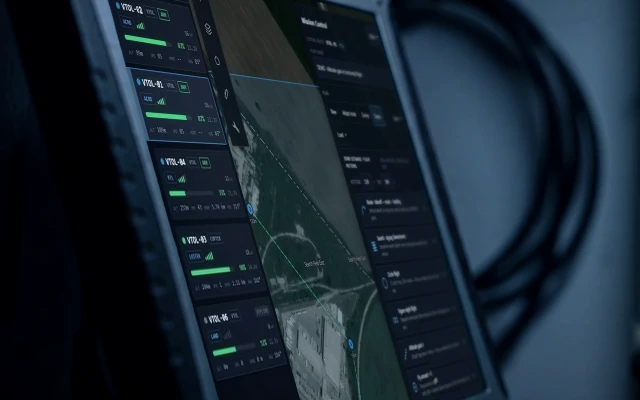
- Redoubt is command and control software that plans missions, shows one live picture and keeps a person in command of every use of force. It is in development and evaluation. See the Redoubt page.
- Ravelin is a printed counter-drone interceptor and Glacis is a long-range vertical take-off surveillance aircraft. Both are prototypes in testing.
- Caisson is an uncrewed heavy-lift resupply aircraft. It is a tested prototype.
- Bartizan, a self-powered sensing tower, and Stillpoint, a portable counter-drone electronic warfare unit, are concepts in development.
These are descriptions of design intent and development status. They are not claims of certification, approval by any alliance or deployment. Where Vaubren’s systems are discussed against NATO or national principles, the principles are the benchmark and the systems are evaluated against them as development proceeds. Readers interested in how detection and counter-drone functions work in general can read Vaubren’s explainers on counter-drone systems in Europe and electronic warfare.
Explore Vaubren’s systems
Procurement, capability and partnership teams assessing how a person-in-command approach applies to command software can start with Redoubt, which Vaubren describes as in development and evaluation. Organisations interested in research, integration or supply relationships can begin at the suppliers page, or visit vaubren.com for the full set of systems.
FAQ
Does the EU AI Act regulate military AI?
No, not where the AI is used exclusively for military, defence or national security purposes. Article 2(3) of Regulation (EU) 2024/1689 excludes such systems from its scope. Dual-use products may still meet the Act through their civilian use, so legal advice on the specific product is sensible.
What are NATO’s Principles of Responsible Use for AI?
They are six principles set out on 22 October 2021: lawfulness, responsibility and accountability, explainability and traceability, reliability, governability and bias mitigation. NATO’s July 2024 revised strategy confirms them while emphasising faster adoption. They are allied policy rather than a binding legal instrument.
What is meaningful human control?
It means a person has enough understanding, authority and time to oversee and intervene in a system’s actions, particularly decisions involving force. UK MOD material links it to clear chains of command, documented abort authority and pre-deployment testing. Exact definitions vary between nations and organisations.
What do defence suppliers need to do about AI assurance?
Under UK MOD guidance, suppliers need their own AI assurance processes to gather key information on their systems and test that they are fit for purpose. The MOD may add assurance checks during procurement. Requirements in other countries differ, so check the relevant ministry’s current guidance.
Sources
- NATO, Summary of the NATO Artificial Intelligence Strategy (22 October 2021)
- NATO, Summary of NATO’s revised Artificial Intelligence strategy (10 July 2024)
- UK MOD, JSP 936 Part 1, Dependable AI in Defence (v1.1, November 2024)
- UK MOD, The importance of AI assurance in Defence
- UK MOD, Responsibility for assuring AI in Defence
- European Defence Agency, Trustworthiness for AI in Defence white paper (9 May 2025)
- Verfassungsblog, The AI Act National Security Exception
- Ethics and Information Technology, Establishing human responsibility and accountability (2025)
- AI Maestro Hub, Ethical AI standards
About Vaubren
Vaubren is a European defence technology company developing aircraft, command software, sensing and electronic warfare as one integrated system, with a person in command of every use of force.
More insights
STANAG 4586 Overview: NATO UAV Control InteroperabilitySTANAG 4586 explained: purpose, architecture (CUCS, VSM, DLI), the five levels of interoperability, editions and what compliance means in practice.UAV Autonomy Levels: Frameworks, Limits and Human ControlHow UAV autonomy levels are defined, why no single international scale exists, and what each framework means for human control and survivability.Drone Swarms: How They Work and How Europe Is AdaptingWhat a drone swarm is, how swarms coordinate, and how European air defence is adapting through detection, command and control, layered interception and cost.